
EB Report
Bangladesh has secured $447,000 in grants from the United Nations Food and Agriculture Organization (FAO) to improve pesticide safety and support environmentally friendly businesses led by rural women.
The grants will fund two separate projects, with $200,000 allocated to safer pesticide management and $247,000 directed toward women-led green micro-enterprises.
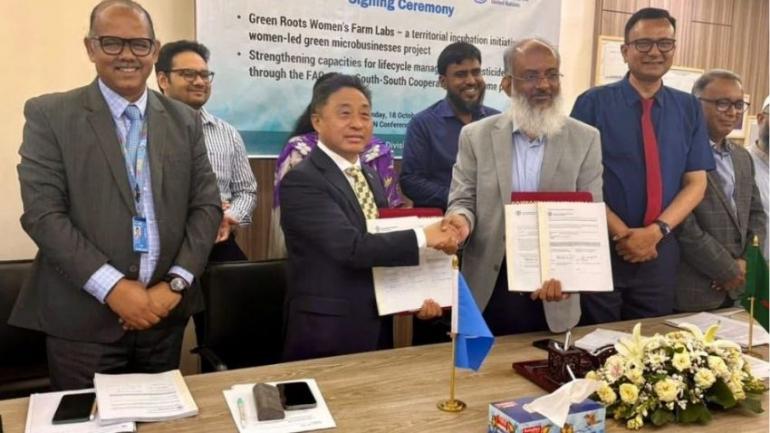
The Economic Relations Division (ERD) under the Ministry of Finance and FAO signed the two project documents in Dhaka on October 18. ERD Secretary Md. Shahriar Kader Siddiky and FAO Representative in Bangladesh Dr. Jiaoqun Shi signed the documents on behalf of their respective organisations.
The initiatives aim to strengthen agricultural safety, improve rural livelihoods and expand economic opportunities for women.
The first project will focus on strengthening pesticide regulation, testing and enforcement amid concerns about chemical residues in agricultural produce.
According to the project document, more than 30 percent of vegetables in Bangladesh are reported to contain excessive pesticide residues.
The four-year initiative, titled “Strengthening Capacities for Lifecycle Management of Pesticides,” is part of the FAO-China South-South Cooperation Programme, funded by China’s Ministry of Agriculture and Rural Affairs.
Bangladesh will receive $200,000 under the programme, which also covers Ethiopia, Ghana, Jordan and Kyrgyzstan.
The project will support updates to pesticide regulations, introduce digital registration systems and strengthen enforcement mechanisms. It will also improve laboratory capacity for pesticide residue testing and raise farmers’ awareness of safe pesticide use.
FAO revised the project document following an inter-ministerial meeting held at ERD on June 10, 2026.
Under the revised arrangements, Bangladesh’s Ministry of Agriculture will lead the Project Task Force, while the Bangladesh Agricultural Research Institute (BARI) will participate in implementation. The National Project Coordinator will be based in Bangladesh, and the project budget has been rationalised.
The second grant, worth $247,000, will support “Green Roots Women’s Farm Labs,” a 24-month sub-programme being piloted in Bangladesh and Uganda.
Building on FAO’s Farmer Field School approach, the initiative aims to help rural women establish and expand environmentally friendly micro-businesses.
The programme will provide coaching, appropriate technologies and improved access to finance and markets to help women develop sustainable business activities.
Its national partners in Bangladesh include the Ministry of Agriculture, the Department of Agricultural Marketing, the Department of Agricultural Extension and Sara Bangla Krishak Society.
The initiative also coincides with the International Year of the Woman Farmer 2026, highlighting the role of women in agriculture and rural economic
Speaking at the signing ceremony, FAO Representative Dr. Jiaoqun Shi said the organisation would continue supporting Bangladesh’s agricultural development.
“FAO is pleased to support the Government of Bangladesh in building safer agrifood systems and creating opportunities for rural women,” she said.
ERD Secretary Md. Shahriar Kader Siddiky said the two initiatives reflected shared priorities in agricultural safety, climate resilience and women’s economic participation.
“These projects reflect our shared commitment to safe food, climate-resilient livelihoods and women’s economic empowerment. ERD will continue to facilitate effective coordination so that results reach farmers and rural women,” he said.
A K M Sohel, chief of ERD’s United Nations Wing, described FAO as a trusted development partner of Bangladesh since independence. He said the UN agency had invested more than half a billion US dollars in improving the country’s agricultural sector.
Sohel also moderated the signing ceremony, which was attended by Dr. Kazi Shahjahan, joint secretary of ERD’s UN Wing, and officials from relevant ministries and government agencies.
ERD coordinates external development resources for Bangladesh, including assistance from United Nations agencies. FAO, a specialised UN agency, leads international efforts to combat hunger and improve nutrition and food security.
The two projects are expected to contribute to safer agricultural production, stronger pesticide management and expanded economic opportunities for rural women.